

• About Me
  • LXD Portfolio
    • Project 1
    • Project 2
    • Project 3
  • Resume
  • More
    • About Me
    • LXD Portfolio
      • Project 1
      • Project 2
      • Project 3
    • Resume
  • About Me
  • LXD Portfolio
    • Project 1
    • Project 2
    • Project 3
  • Resume

Project Title: Is There a Long Wait? No fear, De-escalate!

I designed this learning journey for Emergency Room Nurses who need to de-escalate increasingly frustrated patients during long wait times caused by overcrowding.

Experience This Project Now

Key Aspects of this Project

The problem this learning journey solves: Emergency department nurses frequently encounter patients whose frustration escalates due to long wait times and overcrowding resulting in verbal aggression, strained interactions with providers, and increased risk of workplace incidents.  Current de-escalation approaches are inconsistent and rely heavily on individual experience rather than standardized and evidence based communication strategies.  This learning journey addresses the need to equip ER nurses with practical, repeatable de-escalation skills to improve patient communication outcomes, reduce escalation events, and increase nurse confidence and safety in high-pressure emergency care environments.

Business Goal: Reduce patient frustration incidents during extended ER wait times

Learning Audience: Emergency Room Nurses

I began this project by translating the business goal, which was reducing patient escalation events in the emergency department, into measurable performance outcomes tied to operational indicators like incident reports, patient wait times, safety reports, nurse confidence ratings, and frontline healthcare KPIs that leadership already tracks.  I don't start with the content and media, but for this project I could already visualize what the learning ecosystem would look like based on clearly dentifying the business goal.

The primary learning audience for this project is emergency department nurses.  To design effectively for this audience, I focus on understanding their lived workflow challenges, daily responsibilities, communication demands, and the environmental factors that contribute to the patient escalation.  After understanding who they are, what they experience, and where the performance gaps exist, I was able to begin my process.
My Process

I always aim for my learning journeys to be structured and evidence based.  My go to method is the industry standard, ADDIE model, which helps me to create an experience that will resonate with the learner.  Through analysis, the first aspect I clearly identify is the business goal as well as the learning audience.  With this in mind, I also analyze the performance gaps, in this particular project the performance gap was in nurse confidence and evidence based communication strategies to de-escalate high stress patient interactions.  After analysis I move into the next phase where I mapped a learner centered journey using scenario based practice and communication frameworks that are aligned to real ER conditions.

Action Mapping

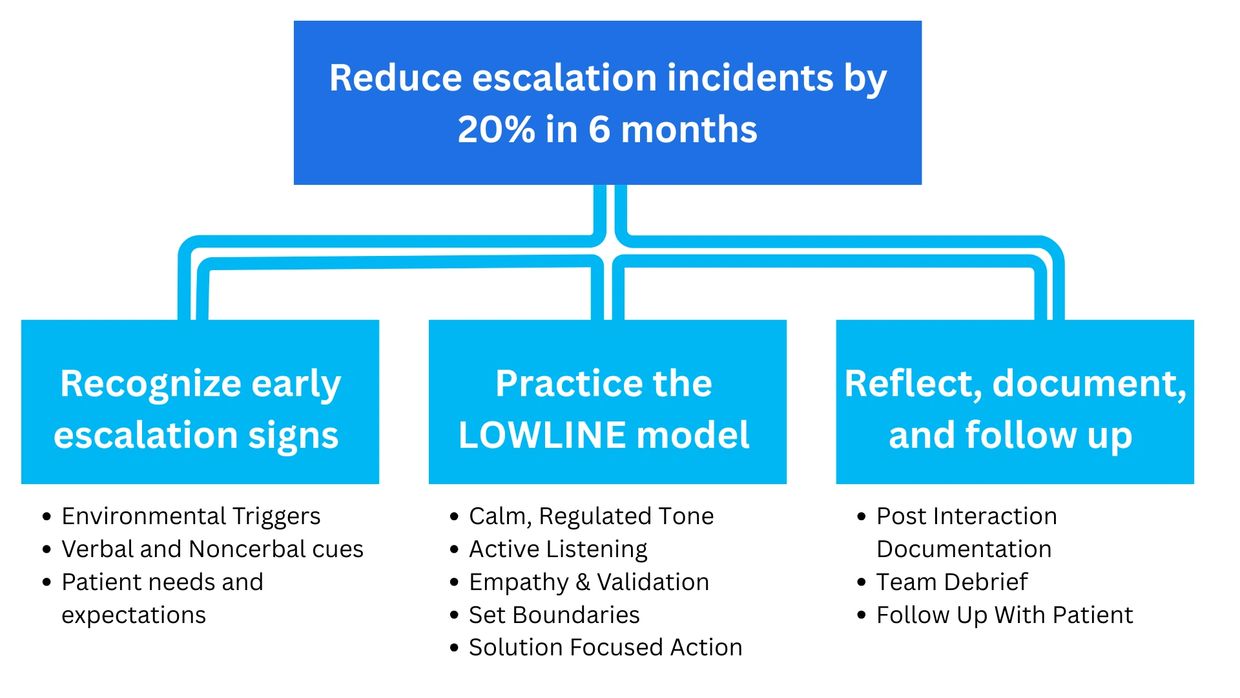
Mapping a learner centered journey is the best way to ensure the content resonates with the audience.  Below is the action map showing the specific actions ER nurses need to take to de-escalate high stress patient interactions.  Focusing on the actions nurses will take in real moments of escalation creates more successful behavior change and stronger performance outcomes.  To better understand the audience I am creating a learning journey for, consultation with a subject matter expert (SME), in this case an experienced Emergency Room Nurse is crucial.  

Identifying these specific actions supports the business goal of reducing escalation events, improving the patient experience, and increasing nurse confidence and safety.  These actions will be the focus of the learning journey to drive behavior change and measurable results.


Storyboard

After finalizing the actions that ER nurses will take to de-escalate high stress patients, I get the action map approved.  I then use the actions on the approved action map to create a script based storyboard.   Using scenario based examples and questions that the nurses will complete, I weave a cohesive storyline from start to finish. 


I created this storyline around a central character named Nurse Jenn.  Nurse Jenn is an emergency room nurse just like the learning audience, but she isn't perfect, she makes mistakes along the way.  Helping an imperfect character navigate this learning journey allows the learner to connect actions with real world outcomes.  The learner will follow the journey of Nurse Jenn and help her decide the best actions to take based on the skills they will learn during the learning journey.  

Visual Mockups

After getting approval on any industry standard language needed in the the script based storyboards, I move onto the visual mock-up phase.  I use the Articulate 360 library and AI to begin to create the world where this learning journey takes place.  I create a mood board with  key visual elements that exist in the world and need to be illustrated.  For example, this project has 3 key visual elements that need to be illustrated: a crowded waiting room in the emergency department, agitated patients, and emergency room nursing staff.  I create the entire world for the storyline to exist in to maintain consistency and high quality throughout the project.


Visually, I always aim to design a logical but creative environment that speaks to the issue at hand, in this case a hospital setting.  In the Articulate 360 library, I searched through mockups of hospital environments and ultimately decided on designing an environment based on a few examples I found. I knew that the people that existed in this environment were the most important visual element of the storyline.  I made all of the people as consistent and realistic as possible while leaving room for a bit of dramatization of the scenarios, this keeps the learning journey engaging.


Last, but certainly not least, I decided on button placement and prompt boxes. For this project, I felt it was appropriate to use callouts or word balloons to truly illustrate the speaking points.

I decided on the logical progression of the storyline from start to finish using my consistent visuals.  The learners will be able to follow along and participate in choosing which way to handle the scenarios.  This style learning truly brings the story to life and engages the learner from start to finish.

Interactive Prototype

Please feel free to email me directly to view the full learning experience: Laneece2029@gmail.com

Email for Experience

My Personal Reflections

Building every project from start to finish is always an exciting journey for me.  I'm blessed because this is what I truly enjoy doing.  As a performance improvement specialist with a graduate level background in psychology, my mindset always goes straight towards solutions to business problems and closing performance gaps with true behavior change.  The metrics are what I look for.  


In this project, I found myself immersed in the design element of the project from the start.  For every project I complete, I take creative liberties to thoroughly design the entire world where the learning experience will take place.  This project was special to me because recently I have become a caregiver for my grandmother, so this means spending extended time in hospital settings.  I was able to use some of my own reference points during designing.  We've all been there.  But, for me, remembering the human experience in every project is a top priority.  Every project I work on has a uniquely human centered aspect that must be highlighted in order for businesses to truly see change and growth.  


Copyright © 2026 Learning Experience Designer & Performance Improvement - All Rights Reserved.

Powered by

This website uses cookies.

We use cookies to analyze website traffic and optimize your website experience. By accepting our use of cookies, your data will be aggregated with all other user data.

Accept